Sound Familiar?
You're Not Lazy. You're Not
Getting Older Faster Than Normal.
Something Else Is Going On.
If you're between 35 and 55 and you've been feeling like your brain just isn't cooperating the way it used to — you're not imagining it. And it's probably not what you think it is. The real culprit is hiding in plain sight, and most doctors never mention it.

The Brain Fog That Won't Quit
You walk into a room and completely forget why you're there. You re-read the same email three times. Your thoughts feel like they're stuck in molasses — slow, scattered, and frustratingly out of reach. You used to be sharp. Now it takes real effort just to stay focused for an hour. And no amount of coffee is fixing it.

Stress That Lives in Your Head 24/7
The mental load never actually stops. Work deadlines, family responsibilities, financial worries, the never-ending scroll of bad news — your brain is constantly running on high alert. You feel wired but exhausted at the same time. You go to bed tired and wake up tired. The stress isn't just emotional anymore. It's physical. It's in your head, literally.

A Flatness That's Hard to Explain
It's not full-blown depression. But it's not okay either. Things that used to excite you just... don't anymore. You go through the motions. Your drive has dimmed. Getting started on anything — even things you care about — feels like pushing through wet concrete. You miss feeling motivated. You miss feeling like yourself.

Memory That's Starting to Worry You
Names you should know. Appointments you forgot. Words that disappear mid-sentence. You joke about it because that's easier than admitting it worries you. But privately, you wonder if this is just how it is now — and whether it's going to keep getting worse. You're not ready to accept that. You shouldn't have to.
1 in 3
Adults 35–55 report significant brain fog affecting daily performance
77%
Of Americans report chronic stress that impacts their cognitive function
~30%
Decline in BDNF levels from young adulthood to middle age, per research estimates
12 min
Daily time investment with The Brain Song to begin supporting BDNF activity
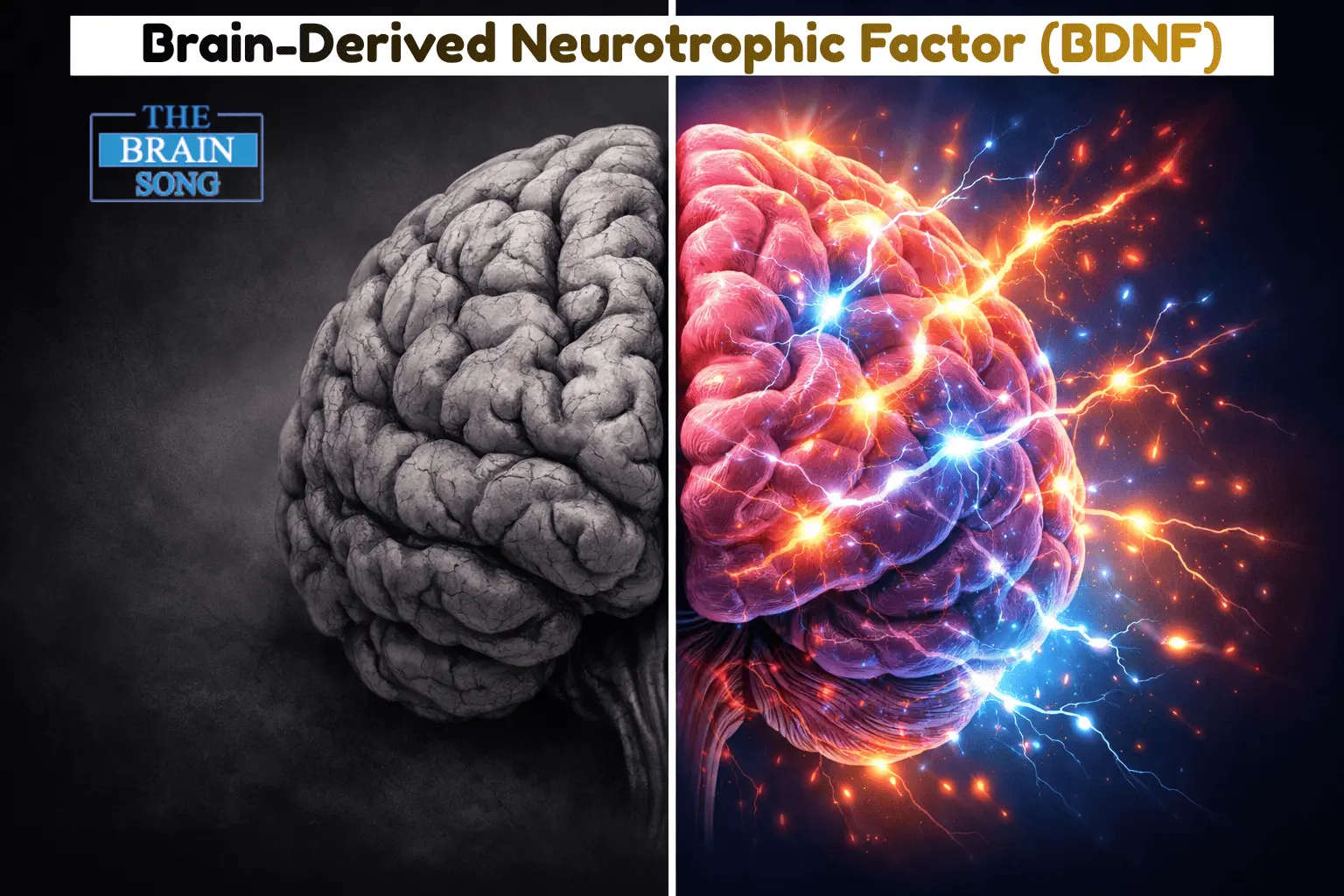
Here's what most people never get told: the symptoms above — brain fog, chronic stress, low mood, poor memory — are not just lifestyle problems. They are biological signals. And one of the most common biological roots is a deficiency in a molecule your brain produces naturally. A molecule neuroscientists have been studying intensely for decades. A molecule they call "fertilizer for the brain."
Its name is BDNF — Brain-Derived Neurotrophic Factor. You've probably never heard of it. Most people haven't. But the neuroscience community has known about it since the 1980s, and the research connecting low BDNF to brain fog, stress sensitivity, low mood, and memory decline is substantial and well-documented.
The problem is that BDNF naturally declines as we age — and modern life accelerates that decline dramatically. Chronic stress suppresses it. Poor sleep depletes it. Sitting at a desk all day reduces it. The result is a brain that's running on less and less of the very protein it needs to function well. And most of us are walking around in that state without knowing it.
The good news? BDNF is not fixed. It responds to what you do. And one of the most promising — and accessible — ways to support it naturally is through something most people would never expect: a specific kind of sound.